Showing posts with label Addiction and Grace. Show all posts

Saturday, February 6, 2010

Happy Horseshit, The Addictive Society and Substance


I have an anonymous commentor who isn't impressed with Eclectic Recovery. I initially responded with anger and struck back because I honestly don't understand people who feel the need to strike out at others from their own hurt places. I usually turn that hostility inward. Neither way is very effective. Anonymous indicated that I am being selfish and have no interest in helping others and nothing could be further from the truth. I'm reminded of a video I saw by Father Martin in treatment in which he stated that the worst pain can come from having your intentions misinterpreted. Father Martin was right about that.

Anonymous called my last post "happy horseshit" and I won't disagree with him/her on that score. The more happy horseshit I develop in my life the more joyful and fulfilling my recovery. Anonymous also indicated that I wasn't writing anything here of substance and with that I have to take exception. Perhaps he/she doesn't understand how to find their way around a blog so here are links to some of my more informative posts on recovery from addiction: Post Acute Withdrawal, dealing with pain, practicing radical accpetance, negative emotional states. cooking in recovery, Medicine Wheel recovery, reviews on recovery books here, here and here, nutritional supplements, gratitude, and H.A.L.T. Just to name a few. Also, if you're interested, there's plenty in the blog archives (which you can reach by scrolling through the date entries in the left-hand column) about what hasn't worked. I've been honest about my failures and successes here and I've had quite a few slip-ups in my attempts at sobriety. Also in the left-hand column are links to other websites I utilize and find helpful - some directly related to recovery from addiction, some not.

I'm reading a book now, "Willpower's Not Enough" by Arnold Washton, Ph.D., and Donna Boundy, M.S.W. which is a very practical, informative and easy-to-read missive about dealing with addictions. There's a chapter titled, "The Addictive Society" and here's an excerpt:

It is now widely known that children growing up with chemically-dependent parents are at high risk for developing addictions themselves. But what we are just starting to realize is that growing up in an addictive society affects us all too - in many of the same ways.
In fact, it may be all but impossible to grow up in our present culture and not acquire at least some vulnerability to addiction. That's because the addictive personality traits (an emphasis on image, cravings for power and control, denial, dishonesty, just to name a few) are increasingly reflected in society's values and trends. And it's a self-perpetuating process. Certain trends create the conditions in which addiction thrives, and growing numbers of addictive people reinforce these trends.
Our society, in a sense, is becoming a large dysfunctional family. And just as children in dysfunctional families become prone to addiction as they try to adapt to their troubled family, so too are we becoming more addiction prone as we try to adapt to the larger dysfunctional system in which we live.

In other words, it's become the ocean we swim in. We don't even notice how bombarded we are by sick, abusive and violent messages; we don't stop long enough to hear our own heartbeat and we certainly don't listen out for anyone else's.

I have long been frustrated about how society uses addicts and alcoholics as scapegoats for their own shadow aspects. There are many shadow tendencies that are not as overt as chemical depdency but which are just as destructive for society and the individuals that make up society. For instance: sexual addiction, gambling, corporate greed, animal and earth cruelty, image glorification, misuse of food and many, many others. Anonymous' behavior is a small example of the problem: visit a blog, read one post, decide it's crap and attack the person writing it. My little blog may not be doing much to heal society's ills, or even my own, but it's a start to being the change I'd like to see in the world.

So thanks, Anonymous, for making me think, take another look at what I'm doing here and giving me something to write about today.

Sunday, May 25, 2008

Pondering


I've been watching Oprah's series with Eckhart Tolle on his book, A New Earth. In one of the segments, a woman skypes in and talks about an illness that has overtaken her life, that has defined it to a point that she no longer wishes to live. She asks how to move away from being her illness. Eckhart's response to her is to stop feeding the energy (my words), not talk about the illness except with her doctors and begin to place more attention on all the areas in which she has well-being in her life.

In a way, that's what I've been doing with this blog and my own definition of myself as "alcoholic." But I'm realizing that even when I'm sober, I'm still feeding that energy - that very energy that I no longer wish to live.

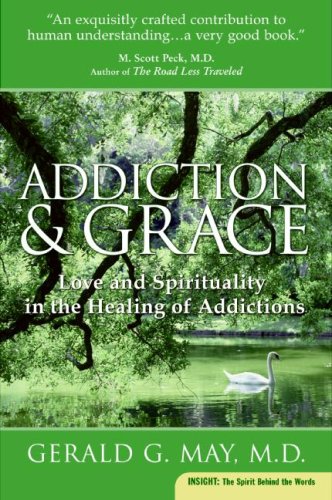
In the book, Addiction and Grace, Gerald G. May describes addiction thusly:

Addiction exists wherever persons are internally compelled to give energy to things that are not their true desires. To define it directly, addiction is a state of compulsion, obsession or preoccupation that enslaves a person's will and desire. Addiction sidetracks and eclipses the energy of our deepest, truest desire for love and goodness. We succumb because the energy of our desire becomes attached, nailed, to specific behaviors, objects or people. Attachment, then, is the process that enslaves desire and creates the state of addiction.

Further,

Addiction attacks every part of what Freud called our "mental apparatus." Subjectively, however, the attacks seem focused on two primary areas: the will, which is our capacity to choose and direct our behavior, and self-esteem, which is the respect and value with which we view ourselves. Addiction splits the will in two, one part desiring freedom and the other only desiring to continue the addictive behavior. This internal inconsistency begins to erode self-esteem. How much can I respect myself if I do not even know what I really want?

The greatest damage to self-esteem, however, comes from repeated failures at trying to change the addictive behavior. Even if I do feel clear about what I really want, I cannot make myself behave accordingly. I seem to be honestly out of control; yet in all truth, I have only myself to blame. This failure can decimate my self-respect. In some other culture, in a society that reveres the mystery of human nature more than ours does, such failure at self-mastery might not be so devastating. They might even be seen as affirmations of one's essential connectedness with the rest of creation and of one's essential dependency upon the Creator. But in modern Western society, we have come to see ourselves as objects of our own creation. When we fail at managing ourselves, we feel defective.

As usual, I'm not entirely sure where I'm going with this, but I think some important things are coming to my attention. Things I wish to share. There was a time when alcohol and drugs were my primary addictions. The substance that I'm currently physically addicted to, that I can hardly even consider giving up, is nicotine. Caffeine, preferably in the form of really good coffee, is a distant second. Among the non-physical addictions I've become aware of are attention and acceptance from certain people, struggle, seeking, and self-improvement. By focusing on my past problems with alcohol and drugs, I conveniently provide a way to avoid dealing with these other addictions, which in actual fact, cause me more trouble in the present.

I wish I could say I am now ready to tackle them all, but if there's one thing I've come to realize, it's the futility of approaching an addiction in that way. So I will state my awareness of them here and my slight willingness to begin opening myself to the possibility of grace in all areas of my life. I think one way to do this is to use Eckhart's advice and to slowly begin to not feed the energy of my addictions.

What do you think?

Friday, May 9, 2008

Addiction and Grace

I have recently read the book, "Addiction and Grace" by Gerald G. May, M.D. and was so touched by the ideas presented in the book that I'm re-reading it. What surprises me is that many of the ideas Dr. May represents are parallel to the ideas presented in the 12-step model, which you know I have little use for. But for some reason the way Dr. May presents them makes them more palatable to me and I find myself nodding in affirmation, feeling the words and ideas as a truth my cells know something about. This is how the book begins:

1. Desire: Addiction and Human Freedom

After twenty years of listening to the yearnings of people's hearts, I am convinced that all human beings have an inborn desire for God. Whether we are consciously religious or not, this desire is our deepest longing and our most precious treasure. It gives us meaning. Some of us have repressed this desire, burying it beneath so many other interests that we are completely unaware of it. Or we may experience it in different ways - as a longing for wholeness, completion of fulfillment. Regardless of how we describe it, it is a longing for love. It is a hunger to love, to be loved, and to move closer to the Source of love. This yearning is the essence of the human spirit; it is the origin of our highest hopes and most noble dreams.

From the Big Book of Alcoholics Anonymous:

Chapter 4 - We Agnostics

Actually we were fooling ourselves, for deep down in every man, woman, and child is the fundamental idea of God. It may be obscured by calamity, by pomp, by worship of other things, but in some form or other it is there. For faith in a power greater than ourselves, and miraculous demonstrations of that power in human lives, are facts as old as man himself. We finally saw that faith in some kind of God was a part of our make-up, just as much as the feeling we have for a friend. Sometimes we had to search fearlessly, but He was there. He was as much a fact as we were. We found the Great Reality deep down within us. In the last analysis it is only there that He may be found. It was so with us.

I wonder a lot about this idea - that a desire for god is part of our DNA as human beings. What I've stopped wondering about lately is whether it's a part of mine - it surely seems to be. This is where all my images and representations and constructs become confusing, where religious education proves futile. It is not a longing I can attach to anything, it just is - a longing for something that defies definition, a longing that has always been with me, that is much more a part of me than my eyes or the color of my hair, or even the breath of spirit that gives me life in the present moment. It is a longing that I have finally decided to honor.

I also wonder, do you feel this longing?